Wind Hit 38% of Ireland's Electricity in April. Should You Put a Turbine in Your Garden?
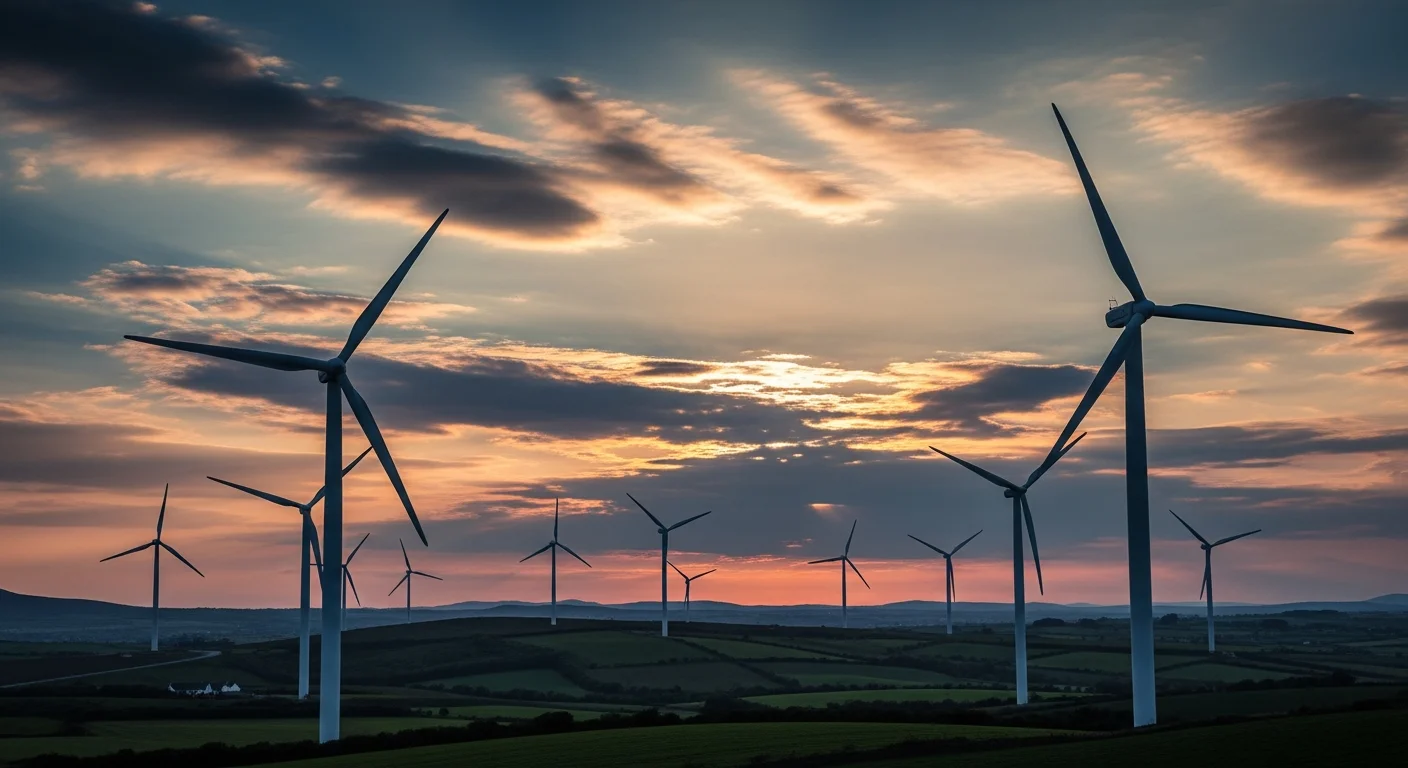
In April 2026, wind farms generated 38% of all electricity in Ireland — the largest single contributor to the grid that month, according to EirGrid's provisional figures. It was the third month in a row that renewables met around half of national demand. That's a genuinely remarkable shift in a country that, twenty years ago, ran almost entirely on imported gas, coal and peat.
So the obvious question, and one we now get asked at least once a week: should I put a wind turbine on my own property?
The honest answer is almost always no. Here's why — and what the 38% figure is really telling you to do instead.
The 38% is utility-scale wind. It's not a product you can buy.
That EirGrid number is industrial wind farms: turbines with blade tips 150 metres in the air, on sites that have had two-year wind surveys before a single foundation was poured, owned by SSE, Statkraft, Bord Gáis Energy and a handful of other operators. They feed straight into the national grid at medium voltage.
It's an extraordinary engineering achievement. It has effectively nothing in common with anything a homeowner can install on their land. The two share a word; they don't share a market.
Three structural problems with home wind in Ireland
1. Planning permission is hard
When solar PV got blanket permitted-development exemptions in 2022, small wind didn't. Domestic wind turbines almost always require full planning permission — which means the neighbours get to object, the council assesses visual impact and noise, and the process can take months. Refusals are common, especially in scenic areas and near boundaries.
Compare that with solar panels, which most homeowners can now install with no planning application at all.
2. The wind resource isn't there at the heights you're allowed to build
Useful, smooth wind starts about 25–30 metres up. At the 10–13 metre tip-height a homeowner can realistically install on a domestic site, you're in the boundary layer — turbulent air shredded by trees, hedges, neighbouring houses and your own roofline.
This matters more than people realise, because the power a turbine produces scales with the cube of wind speed. Average Irish wind speeds at low domestic heights are typically 4–6 m/s; turbines are rated at 11 m/s. The real-world output is usually a fraction of nameplate — often 10–20% capacity factor on a decent rural site, near zero on a typical suburban one.
3. No SEAI grant
SEAI funds solar PV (€1,800), heat pumps (up to €6,500), insulation, BER assessments and EV chargers — the whole retrofit stack. They explicitly do not grant-aid domestic wind turbines, and they haven't for years. That's the state's own energy agency telling you, with money, where the residential payback case stacks up and where it doesn't.
The numbers, honestly
A typical 5 kW domestic wind turbine in Ireland:
- Installed cost: €15,000 – €30,000 depending on tower height and groundworks
- Realistic annual output (good rural site): 4,000 – 7,000 kWh
- Grant: none
- Simple payback: 15 – 25 years on a good site, never on a poor one
A 5 kWp solar PV system on the same house:
- Installed cost: ~€9,000 before grant, ~€7,200 after the €1,800 SEAI grant
- Realistic annual output: ~4,500 kWh
- Simple payback: 6 – 9 years
- Planning: none required for most homes
- Maintenance: essentially zero for 20+ years
Solar produces roughly the same output, for a third of the net cost, in a third of the payback time, with no planning fight and no moving parts.
The narrow exception
There is one case where small wind genuinely can work: a large rural or agricultural site with proven exposure to prevailing wind, no neighbours close enough to object, and an existing high electricity load to soak up the output (a working farm, a rural business, a horticulture operation). For those owners a 6–15 kW machine can pay back in a reasonable timeframe — especially paired with battery storage.
If that's you, the answer isn't a CleanEnergy.ie quote — it's a one-year on-site wind survey from a specialist consultancy before anyone quotes you a turbine. We don't list small-wind installers because nationally there are only a handful, and the lead quality for a category that fits maybe 1% of enquirers isn't fair to the trade.
What the 38% figure is really telling you
It's telling you the electricity grid you plug into is getting cleaner every year. That changes the economics of everything that runs on electricity.
A heat pump using grid power in 2026 Ireland is, on a carbon basis, dramatically cleaner than the oil boiler it replaced — and gets cleaner every year as wind, solar and offshore capacity comes online. An EV charged off the grid is doing the same. A home with rooftop solar plus a smart night-rate tariff effectively gets the cheap night-time wind generation for next to nothing.
The right reaction to "wind hit 38%" isn't "I should buy wind." It's "I should plug more of my house into electricity, because electricity in Ireland is getting cleaner and cheaper faster than any other fuel."
The honest answer
- Don't install a domestic wind turbine. The economics don't work for 99% of Irish homes.
- Do install solar PV if you have a south, east, or west-facing roof — payback is well under a decade, the grant is generous, and you're future-proofed for the next 25 years.
- Do consider a heat pump if your home is reasonably insulated and you're on oil or LPG. The grid is the cleanest fuel you've got access to.
- Do switch to a smart electricity tariff so you're paying night-rate prices when the grid is wind-rich. That's how a homeowner actually benefits from the 38% figure.
CleanEnergy.ie matches you with SEAI-registered solar PV and heat pump installers in your county. Three quotes, no pressure, free for homeowners.